
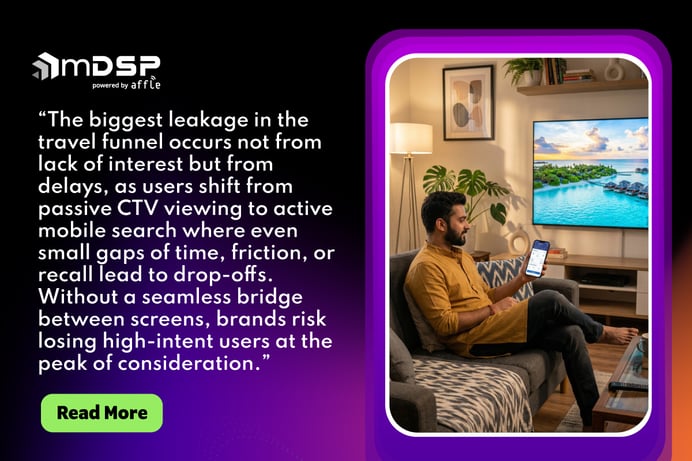
The start of the travel season in India is no longer just about rising search volumes, but rising intent shaped across screens. Today’s travel decisions often begin on the largest screen in the home and end on the smallest one in hand. Surveyed travellers in India use seven touchpoints on average for inspiration, which makes early visual recall especially valuable for brands trying to stay in consideration as the journey moves toward booking.
India’s next phase of travel growth is being shaped by a new kind of consumer who is digitally native, mobile-first, and increasingly aspirational. From metro cities to Tier 2 and Tier 3 markets, travel is no longer an occasional luxury but a planned, frequent experience. Affordable data, UPI-led payments, and app-first ecosystems have accelerated this shift.
These audiences are younger, highly aspirational, and deeply influenced by visual and video-led content. They may discover destinations through streaming platforms, social content, or shared screens at home, but when it comes to action, they turn to mobile. This creates a unique challenge for travel marketers: how to convert mass-market inspiration into individual, high-intent bookings in real time. But as demand scales, so does complexity. Consumers are discovering destinations across more touchpoints than ever before, making it harder for brands to convert inspiration into immediate action.
Travel is Already a Mobile-First Category
Mobile sits at the heart of the travel journey in India—it is where users research destinations, compare prices and itineraries, consume reviews and short-form content, and ultimately complete bookings and payments. For most consumers, the entire path from inspiration to transaction has been compressed into a single device, making mobile the default interface for travel decision-making. Nearly 44% of travellers take more than a week, on average, to plan and book a vacation, and 85% prefer to book trips online. India’s online travel booking service market is projected to reach about $57.9 billion by 2030, with device-based growth increasingly shaped by mobile usage. Younger audiences are accelerating that momentum. Around 42% of millennial travellers and 89% of Gen Z travellers in India say they plan to increase their travel budgets, which points to an audience that is highly digital, receptive to visual imagery, and responsive to travel inspiration that can move quickly into mobile action.
However, as content consumption increasingly shifts to Connected TV, this mobile-first behavior is evolving into a dual-screen dynamic where discovery happens on the big screen, but action still happens on mobile. A user may see a destination on TV, search for it later on mobile, and drop off somewhere between curiosity and checkout. Connected TV fits the first role with remarkable strength, giving travel advertising a premium visual environment inside the home. In India, that opportunity now carries real scale, with 35-45 million CTV households in 2025 and average daily TV viewing crossing 3.5 hours. For travel brands, that make the CTV screen is especially valuable at the point where visual recall can begin shaping intent. Mobile then carries that interest forward into app visits, offer exploration, and booking intent, creating a cross-screen journey that aligns closely with how travel decisions take shape.
That distance between inspiration and action is where many travel conversions are lost, which is exactly why the connection between the two screens matters so much.
How CTV App Sync Closes the Missing Link Between Discovery and Conversions
The biggest leakage in the travel funnel does not happen due to lack of interest, but due to delay. When users move from passive viewing on CTV to active search on mobile, even small gaps such as time, friction, or recall can lead to drop-offs. Without a direct bridge between screens, brands risk losing high-intent users at the exact moment when consideration is strongest.
-
QR codes shorten the conversion journey.
When the QR code stays visible throughout the ad and leads directly to the app store, it gives viewers a clear path from large-screen attention to mobile action. Paired with a simple CTA such as scan or download, it removes the delay of remembering the offer and searching for it later, making the journey faster, cleaner, and easier to convert.
- Measure what happens after the big screen: Use Household-level matching and MMP-based attribution can connect CTV exposure with downstream mobile actions such as installs and registrations.
- Dynamic creative improves relevance.
- The two screens perform different jobs.
Actionable Strategies for Travel Marketers This Season in India
Travel demand in India is already in motion, with consumers actively exploring destinations, comparing options, and planning upcoming trips. In this phase, the advantage lies in how quickly and seamlessly brands can move users from discovery to action.
To capture this intent more effectively during the current travel season, travel marketers should focus on a few clear priorities
- Make every CTV impression actionable
Ensure ads include a clear next step—QR codes, app-first CTAs, or direct install prompts—so users can respond immediately without relying on recall. - Prioritize mobile landing experiences
The transition from screen to screen should feel effortless. Fast-loading app store pages, deep links, and simplified onboarding flows can significantly reduce drop-offs. - Align messaging across screens
What users see on CTV should carry through to mobile. Consistent creatives, offers, and destination cues help reinforce intent and shorten decision cycles. - Measure beyond installs
Track downstream actions like registrations, searches, and bookings to understand how CTV exposure is contributing to actual travel outcomes.


-1.png)