
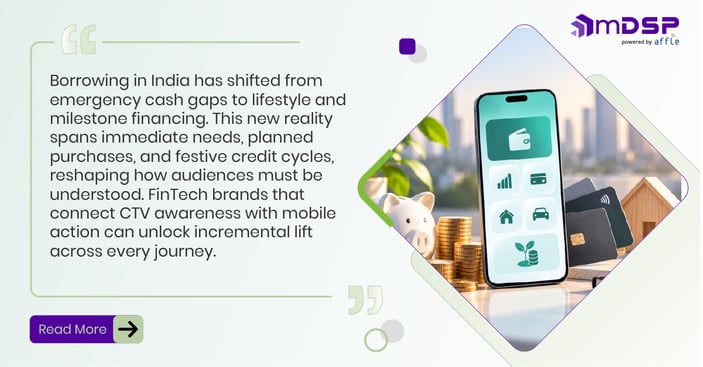
For a long time, the idea of borrowing in India was closely tied to necessity. A medical expense that could not wait. A temporary cash-flow gap. A large purchase that was difficult to fund upfront.
That relationship with credit is changing.
Credit is increasingly becoming part of how consumers plan purchases, manage milestones and access things they want sooner. A smartphone on EMI, a two-wheeler for daily mobility, education financing or credit for a small business can all represent very different reasons to borrow — and increasingly, these decisions are being made by consumers who have grown up with digital financial services.
At the same time, the Indian borrower itself is changing. The expansion of formal credit is reaching younger consumers and moving beyond the traditional metro markets. More first-time borrowers are entering the system, while existing borrowers are becoming more conscious of their credit profiles and increasingly monitoring their scores.
That makes the idea of a single “FinTech consumer” increasingly difficult to defend and is changing the idea of FinTech user acquisition in India. It is becoming less about a single shift from cash to credit and more about the emergence of multiple borrowing journeys.
And that has implications for how FinTech brands think about their audiences.
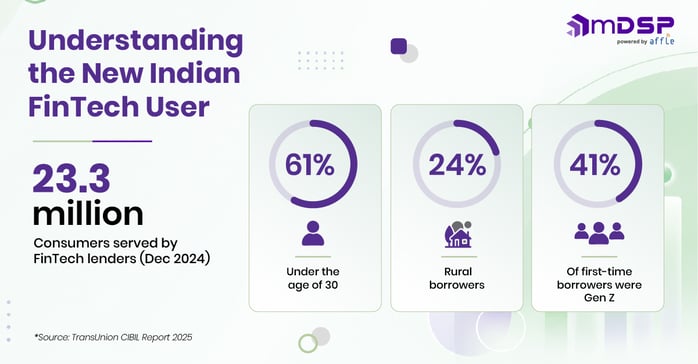
The Indian FinTech user is no longer a single audience with a single reason to borrow.
There is the consumer looking for money immediately. Another is planning a purchase several weeks from now. And then there is someone entering the formal credit system for the first time. And there are consumers whose borrowing behavior is shaped by predictable moments in the calendar — from the festive season to education cycles, weddings and other major spending periods.
For FinTech marketers, understanding these different journeys may matter as much as understanding the consumer's demographic profile.
Four FinTech User Segments, Four Acquisition Realities
Treating FinTech users as one audience is the most expensive assumption in the category.
Two consumers in the same age group, city and income bracket can have completely different relationships with credit. One may be a first-time borrower exploring eligibility. Another may already have a credit relationship and be looking to finance a planned purchase. A third may only become relevant around a predictable spending moment such as the festive season.
The opportunity is to move from broad borrower pools to meaningful audience segments based on intent, behaviour and credit journey.
Some of the most useful segments may include:
- Immediate-need borrowers — Consumers actively looking for short-term credit or responding to an urgent financial requirement. The window between consideration and action is narrow, making recency and high-intent signals particularly important.
- Planned borrowers — Consumers researching a larger purchase such as a two-wheeler, smartphone, consumer durable, or education, where financing is part of a longer consideration journey. The credit need may emerge only after the purchase intent is already established.
- New-to-credit consumers — Consumers entering formal credit for the first time. Here, the challenge is not simply identifying intent to borrow, but recognising the signals that indicate financial readiness and relevance.
- Existing credit users — Consumers who already understand and use formal credit and may have a higher propensity for another product or borrowing occasion. Their previous relationship with credit can provide a very different signal from a first-time applicant.
- Seasonal or occasion-led borrowers — Consumers whose borrowing is linked to predictable moments such as festive purchases, weddings, travel or education cycles. Their intent may be dormant for much of the year and become highly relevant within a defined window.
That is where audience intelligence becomes important.
Rather than treating the FinTech audience as a single pool to be reached as efficiently as possible, marketers can build segments around who the consumer is, what they are doing, what they are likely to need next and how close they are to taking action.
Why the Festive Season Sharpens the Divide
The festive quarter compresses all four behaviors into a few weeks. Everyday credit rises with shopping volume, aspirational borrowing peaks around gifting and travel, and bonus cycles push investment consideration upward.
A recent survey from an investment brand revealed how differently this user now decides. 42% chose their lender for fast disbursal and low documentation. Only 25% named the interest rate as their top priority. 80% preferred digital platforms to compare and apply. Most valuable for marketers, 41% took a festive personal loan for the first time, and 46% said they were very likely to borrow again next season.
That is a large pool of new users forming category habits in a compressed window. Reaching them at the right moment matters more in this quarter than in any other.
Programmatic Advertising for FinTech Brands: From Audience Segmentation to Intent
Programmatic advertising becomes more valuable when FinTech acquisition moves beyond broad “finance” audiences and starts responding to signals of intent.
A lending platform, for example, may want to prioritise consumers with a higher likelihood of eligibility while suppressing audiences less likely to qualify. Within that pool, it can distinguish between someone actively looking for credit and someone whose behaviour points to a future borrowing need.
For one leading Indian digital lending platform, mDSP built curated cohorts of over 10 million credit-worthy users, with high-risk profiles suppressed before spend began. Registration-to-disbursement reached 44%, while post-install activation of users who stalled before KYC drove a 24% incremental lift in install-to-disbursal conversions.
The same principle applies beyond lending. Two investment and stock-broking platforms used AI-powered audience segmentation during a bear market, delivering 4X growth in installs and a 30% increase in first trades.
The broader shift is from buying broad audiences to responding to intent — and from optimising for installs to optimising towards downstream outcomes.
Connecting the Journey Across Screens
The same audience intelligence can inform how FinTech brands use different screens.
CTV can give brands more space to introduce a financial proposition, explain a product or build familiarity around a considered decision. Mobile remains closer to action — whether that means researching eligibility, completing KYC, applying for credit or making a first transaction.
The opportunity is not to treat CTV and mobile as separate campaigns. It is to connect them around the same consumer journey.
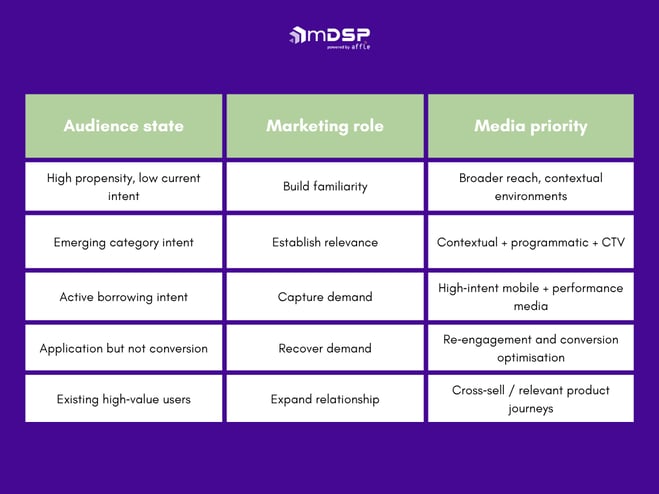
A large-screen environment can give a brand more room to explain a proposition and build familiarity, while mobile remains the natural environment for checking eligibility, researching further, completing an application or transacting.
The important point is to connect the two rather than treat them as separate campaigns.
A consumer exposed to a CTV message may later interact with the brand on mobile. Another may already be showing intent on mobile and require a different performance treatment. The media plan should therefore reflect the audience's position in the journey rather than assigning CTV a blanket “awareness” role.
Building for Borrowers Who Keep Evolving
India’s credit landscape is becoming more diverse, and FinTech acquisition needs to reflect that complexity.
The next phase will require marketers to understand which borrower is ready for what, recognise the signals that matter, and reach them in the right environment as intent evolves.
Mobile and CTV can play different roles, but they can work from the same audience intelligence and contribute to the same conversion journey — bringing together consideration, action and re-engagement rather than treating them as separate media moments.
Unlock the next frontier of performance marketing. Team mDSP enables brands to capture the full value across CTV and mobile. Get started with us: https://mdsp.co/contact-1.png?width=100&height=100&name=image%20(15)-1.png)