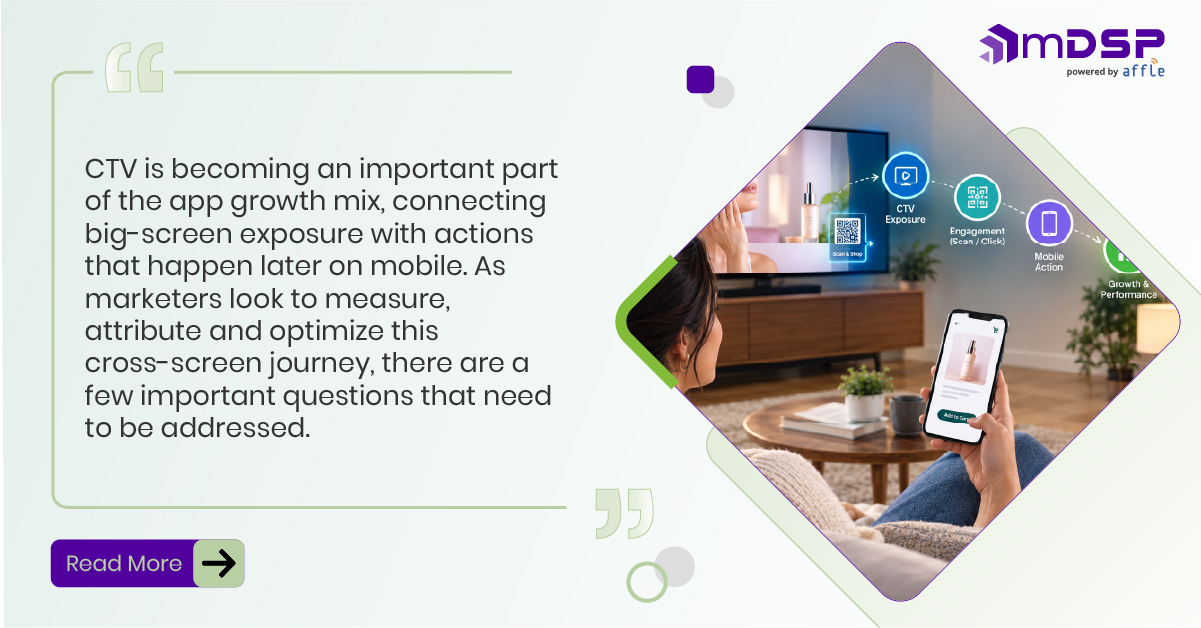
CTV advertising can influence purchases and app installs that happen later on a different device. Between seeing an ad on a connected TV (CTV) and completing a conversion, a consumer may search for a brand, visit a website, explore an app or return to make a purchase. Measuring this journey requires marketers to connect CTV exposure with downstream actions and distinguish attributed conversions from incremental results.
For app marketers, the key question is not simply whether consumers watched an ad. But also going deeper into what happened next, how those actions can be measured and whether CTV contributed to additional business outcomes.
This guide answers 10 frequently asked questions about the journey from CTV advertising to conversion.
1. What happens after a consumer sees a CTV ad?
The journey typically involves four stages:
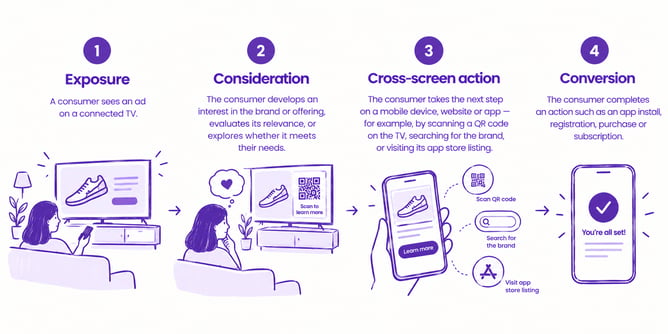
- Exposure: A consumer sees an ad on a connected TV.
- Consideration: The consumer develops an interest in the brand or offering, evaluates its relevance, or explores whether it meets their needs.
- Cross-screen action: The consumer moves to a mobile device, website or app to learn more or take the next step.
- Conversion: The consumer completes an action such as an app install, registration, purchase or subscription.
Between a CTV ad and a purchase, consumers may move through several stages: ad exposure, consideration, cross-screen engagement and conversion. The journey can happen immediately or extend over several days, depending on the product and the consumer's intent. The purpose of performance CTV measurement is to understand which downstream actions can be associated with ad exposure and whether the campaign generated additional conversions.
2. How does CTV advertising drive app installs and purchases on mobile?
CTV advertising can drive app installs and mobile purchases by introducing an offering on television and encouraging consumers to take action on another device. The transition may happen through a QR code, a subsequent brand search, a direct website visit or another measurable interaction.
For example, a consumer might see a financial services app advertised on television, search for it on their smartphone and complete an install. Another viewer might scan a QR code displayed in the ad and visit the app store directly.
Three factors help marketers understand these journeys:
- A clear call to action: Gives viewers a reason to continue their journey after seeing the ad.
- Cross-screen measurement: Connects eligible television exposures with subsequent actions on mobile or web.
- Conversion tracking: Measures outcomes such as installs, registrations, purchases or subscriptions.
3. How can marketers measure conversions when CTV ads do not have clicks?
Marketers can use probabilistic attribution to associate eligible mobile conversions with a preceding CTV impression without requiring a click on the television ad. A mobile measurement partner, or MMP, evaluates recorded impression information against subsequent app activity using the applicable matching rules and attribution window.
Unlike clickable mobile ads, CTV ads do not always provide a direct interaction between the advertisement and the conversion. Marketers therefore need to establish how exposures are recorded, how subsequent actions are matched and which attribution windows apply.
4. What is the difference between CTV attribution and CTV incrementality?
CTV attribution determines which eligible conversions receive campaign credit under defined matching rules and time windows. It helps marketers report outcomes associated with television exposure and compare campaign performance. An attributed purchase, however, does not establish that the advertising caused it.
CTV incrementality estimates the additional outcomes generated because the campaign ran. An appropriately designed study compares a treatment group with a comparable control group held back from the advertising being tested. This helps measure the additional conversions that would not have occurred without the campaign. According to an Adjust study, approximately 30-50% of the total reach on CTV is incremental and exclusive.
This distinction is particularly important in CTV, where consumers may see an ad on television and later convert on another channel such as mobile.
By combining attribution reporting with incrementality testing, marketers can better understand both the conversions associated with CTV and its additional contribution to acquisition. This supports more informed budget allocation and a clearer assessment of CTV's role in the wider media mix.
5. How long after a CTV ad exposure should marketers attribute a conversion?
The time between exposure and conversion depends on factors such as product category, purchase complexity, consumer intent, campaign messaging and the action being measured. Marketers should use the attribution window supported and configured for their campaign’s MMP integration. This defines how far back an eligible advertising exposure can be considered when assigning conversion credit. The appropriate setting must be confirmed against the integration’s available options and attribution rules before launch.
For purchase-focused campaigns, distinguish the window used to attribute an install from the period used to evaluate subsequent purchasing activity. A purchase made by an attributed user is not automatically subject to the same timing rules as the original install. Clearly documenting both settings makes campaign comparisons more meaningful and explains which outcomes the reporting includes.
6. Which metrics should marketers use to evaluate performance CTV campaigns?
Marketers should select metrics that reflect the campaign objective. For app acquisition, attributed installs and cost per install help assess acquisition efficiency. For campaigns focused on registrations or purchases, review the attributed events and cost per defined action. Where purchase revenue is captured and shared through the measurement integration, attributed revenue and return on ad spend provide additional context for evaluating performance.
Compare results using consistent event definitions and observation periods. Where an appropriately designed incrementality study is available, conversion lift and estimated incremental purchases help assess how much additional activity the advertising generated. These findings complement attribution reporting by adding evidence about the campaign’s contribution to growth.
7. What should app marketers look for in a performance CTV partner?
A performance CTV advertising partner should help marketers connect television advertising with measurable app installs, purchases and other conversion outcomes. Key evaluation criteria include cross-screen measurement, transparent attribution, incrementality testing, conversion-quality insights and the ability to optimize campaigns against defined business objectives.
mDSP by Affle focuses on cross-screen programmatic advertising built around measurable conversions, helping advertisers extend acquisition strategies into connected TV while maintaining a focus on downstream outcomes. mDSP’s CTV App Sync solution designed to connect CTV advertising with measurable mobile app outcomes. Through supported mobile measurement partner integrations, CTV App Sync uses household IP matching to help attribute eligible mobile actions following CTV ad exposure.
mDSP also offers incrementality measurement capabilities designed to help advertisers distinguish paid campaign impact from organic growth, evaluate incremental lift and identify where campaign spend can deliver greater incremental value
8. What are the best practices for CTV cross-screen campaigns for measurable mobile conversions?
Marketers should start by defining the desired outcome, whether an app install, registration or purchase, and ensuring measurement integrations capture the relevant conversion events. Clear calls to action, compelling creatives and a frictionless CTV-to-mobile journey can help turn television exposure into measurable action.
Use cross-screen attribution and campaign performance data to evaluate conversions, acquisition costs and audience quality. Solutions such as mDSP’s CTV App Sync help connect eligible CTV exposures with subsequent mobile app activity, while incrementality testing helps estimate the additional conversions generated by a campaign. This gives budget decisions a stronger foundation by combining campaign-level reporting with evidence of additional conversions.
9. How can marketers optimise CTV campaigns for mobile conversions?
Start by defining the conversion events that matter, such as app installs, registrations, purchases or subscriptions. Then review delivery and conversion data together to understand which creatives, audiences and campaign settings are associated with stronger results.
Use attribution data to guide optimisation, while incrementality testing can help establish whether changes are generating additional conversions. The approach should also account for the time lag between CTV exposure and mobile action, so campaigns are not judged solely on immediate responses.
For measurable cross-screen campaigns, platforms such as mDSP support CTV-to-mobile measurement through CTV App Sync, helping marketers assess eligible downstream mobile activity alongside campaign data.
10. How can performance-focused CTV strengthen an app marketer’s media mix?
Performance-focused CTV enables app marketers to extend user acquisition beyond mobile, reaching audiences on the big screen while connecting campaign exposure to downstream mobile actions. Rather than treating CTV as a standalone awareness channel, marketers can evaluate its contribution to app installs, in-app events and other conversion goals alongside their existing media investments.
The Bottom Line