
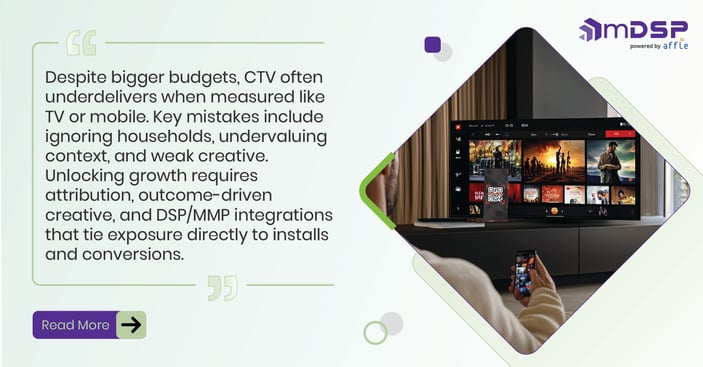
Connected TV has become one of the most discussed channels in modern advertising. Yet despite years of investment and growing budgets, many app marketers still struggle to answer a fundamental question: Is CTV actually driving growth, or is it simply generating exposure?
The problem isn't a lack of supply, audience reach, or consumer attention. Rather, the challenge is that many marketers are adopting CTV without really understanding how to approach this medium, using assumptions inherited from traditional television, even as the channel is more programmatic and digital in its operational behaviour.
Yet despite this rapid expansion and increased investment, many marketers have not fully evolved their measurement and optimization approaches, creating a gap between spend and performance potential.
The result is a widening gap between the potential of CTV as a growth driver and the performance many marketers actually achieve. Understanding how the channel works—and how consumer behaviour differs within it—has become increasingly important as CTV takes on a larger role in the media mix.
Here are five mistakes that can limit CTV's potential for your app’s growth.
Mistake 1: Treating CTV as an Isolated Channel
One of the most common mistakes marketers make is evaluating CTV as a standalone environment.
In reality, consumers rarely complete their journey on the television screen itself.
A viewer might discover a travel app while watching a live sports event, search for it later on their smartphone, compare options on a tablet, and eventually complete a booking through the app. The conversion happens elsewhere, but CTV often plays a critical role in initiating the journey.
This disconnect creates a measurement challenge. When marketers focus only on what happens within the CTV environment, they often underestimate the channel's true contribution to downstream outcomes.
The most effective marketers view CTV as part of a connected consumer journey rather than an isolated media channel. Success should be measured through cross-device actions, influenced conversions, and incremental business outcomes—not simply impressions or completed video views.
The question is no longer, "Did someone interact with the ad on the television screen?"
The better question is, "What actions did exposure on CTV influence across the consumer journey?"
Mistake 2: Treating CTV as Either Television or an Extension of Mobile
One of the reasons many marketers struggle to demonstrate business impact via CTV is because they approach the channel as either television or apply the same principles of digital marketing from mobile to CTV. While the reality is that CTV combines elements of both environments while operating under a completely different set of consumer behaviours.
Unlike traditional television, CTV offers audience intelligence, addressability, real-time optimization, and outcome measurement. Yet unlike mobile, it exists in a lean-back environment where users are not scrolling or clicking the ads. Screens are larger, viewing sessions are longer, and content consumption is often more immersive. Many campaigns underperform because marketers apply television planning frameworks or mobile performance tactics without adapting them to how audiences actually consume content on connected TV.
The most successful advertisers recognize that CTV requires its own playbook. Creative strategy, audience planning, measurement frameworks, and optimization models must be built specifically for the channel rather than borrowed from adjacent media.
💡 Tip: Define a distinct role for CTV before adapting assets or campaign settings. Start with the viewing environment and desired mobile outcome, then build the creative, targeting, and measurement plan around them.
Mistake 3: Planning for a Single Viewer Instead of the Household on a Shared Screen
Mobile advertising usually speaks to one person. The television is typically a shared device. Multiple people may consume content through the same screen, influence purchase decisions, or engage with advertising together. A household may contain viewers from very different age groups, income brackets, and consumer segments. An ad served to a household identified as having an interest in gaming, for example, could be viewed by a teenager, a parent, or both. Similarly, a campaign targeting affluent households may reach multiple decision-makers with different motivations and purchasing behaviours.
This complexity becomes even more important when measuring performance. The person who sees the ad may not be the same person who later downloads the app, creates an account, or completes a purchase. In many cases, CTV influences household-level awareness and consideration before driving action on another device.
Understanding household composition, demographic diversity, shared viewing habits, and cross-device behaviour is critical to building effective campaigns.
For performance marketers, this distinction matters because it affects everything from audience construction and frequency management to attribution and outcome measurement. Strategies designed around a single user identity may overlook the reality that CTV engagement often occurs at the household level. The implication is that marketers need to think beyond individual identifiers and device-level assumptions. Household composition, shared viewing behaviour, and collective decision-making play a much greater role in CTV than they do in many other digital environments.
Mistake 4: Choosing Inventory Before Choosing the Right Viewing Context
As the CTV ecosystem has evolved, marketers today have more choices than ever before. Campaigns can run across premium broadcaster apps, streaming services, FAST channels, and OEM environments. This expansion has created new opportunities to reach audiences across a diverse set of viewing experiences and contexts, making inventory selection a more strategic consideration than simply maximizing scale or reach. For performance marketers, the more important consideration is context.
A consumer watching a live sporting event, binge-watching a drama series, browsing content recommendations on a smart TV home screen, or engaging with a niche FAST channel may be exhibiting very different behaviours, attention patterns, and levels of commercial intent. These environments are not interchangeable simply because they all fall under the CTV umbrella.
This becomes particularly important for app marketers. A gaming app, food delivery platform, fintech app, travel app, or streaming service will not necessarily benefit from the same supply strategy. The environments that drive the strongest outcomes for one category may be entirely different for another.
The mistake many marketers make is starting with inventory and then looking for audiences within it.
The more effective approach is to start with the consumer context and work backwards. Understanding when, where, and under what viewing circumstances an audience is most likely to engage with a category often provides a stronger foundation for performance than simply maximizing reach across available supply.
Mistake 5: Approaching CTV with Only a Branding-First Mindset
Perhaps the biggest mistake app marketers make is continuing to view CTV primarily through an awareness or a branding only lens. Today, CTV is highly addressable, measurable, and increasingly optimized around outcomes. Yet many marketers still fail to build campaigns that support action.
One example is creative execution. A common mistake is repurposing television commercials or mobile videos without adapting them for the connected TV experience. Small text, cluttered visuals, complex messaging, and weak calls-to-action often create friction for viewers sitting several feet away from the screen.
The same challenge applies to QR codes. Too often, QR codes are treated as a design element added at the end of production. In reality, they are often the primary bridge between television exposure and mobile action. Performance-oriented CTV creative should be built around this interaction. QR codes need to be prominent, visible, and displayed long enough for viewers to complete the action.
Next comes measurement: Without robust attribution and optimization capabilities, marketers struggle to understand which audiences, creatives, publishers, and placements are driving the highest-value users. Driving measurable outcomes on CTV requires multiple moving parts to work together seamlessly.
This is where choosing the right DSP becomes increasingly important. Marketers should look for DSP partners that offer full-funnel capabilities, robust audience and optimization tools, and sophisticated integrations with leading mobile measurement partners (MMPs). These integrations help ensure that app installs, in-app events, and downstream conversions can be accurately measured and tied back to CTV exposure, providing the visibility needed to make informed optimization decisions.
The Bottom Line
Connected TV introduces a different set of planning, measurement, and optimization considerations than either traditional television or mobile advertising. Many of the challenges marketers experience with CTV stem not from the channel itself, but from applying assumptions that were designed for other media environments.
As CTV becomes a larger part of the media mix, understanding these differences is becoming increasingly important to realizing its full performance potential.
Unlock the next frontier of performance marketing. Team mDSP enables brands to capture the full value across CTV and mobile. Get started with us: https://mdsp.co/contact
-1.png?width=100&height=100&name=image%20(15)-1.png)



-1.jpg?width=352&name=banner2%20(1)-1.jpg)
-1.png)