Festive marketing has never had a shortage of marketing opportunities. With customer intent at the highest, brands are most inclined for conversions in the weeks leading up to the festive season in India, which accounts for 30% of advertising spends. Yet, this is also a time when marketers face the challenge of allocating their media spends well across channels towards maximizing ROI. The instinct is often to pour spends into the channel that converts the fastest: and that has typically been mobile for most performance marketers. And rightly so – mobile is the primary screen for most customers. But with consumer behavior changing, the second screen phenomenon has emerged where attention is split across screens. CTV is placed at the centerpiece in today’s consumer journeys, and no longer limited to being a brand-only channel, thus changing the equation for many digital as well as legacy brand marketers.
Consumers are constantly moving between moments of discovery, consideration and purchase. They might see a product on their Smart TV, look it up on their phone, and come back to buy days later. It’s also interesting to see that the festive spends are no longer just concentrated during the Diwali week – traditionally the biggest spending season. AppsFlyer's 2025 India Festive Report found that the single Diwali-week spike has become a nine-week sequence of performance opportunities, with high-intent behavior continuing well past the festival peak. This translates into a longer period of opportunities for marketers across timelines and screens to reach and convert users. Because consumers don't experience the festive season one screen at a time, marketers can't afford to plan for it that way either. The challenge is not CTV versus mobile, but how to make both work harder together.
The Festive Opportunity Has Outgrown a Single Screen
The instinct to compare CTV and mobile as competing channels is understandable. Budgets are finite, and every marketer is under pressure to demonstrate outcomes.
But CTV and mobile don't necessarily do the same job.
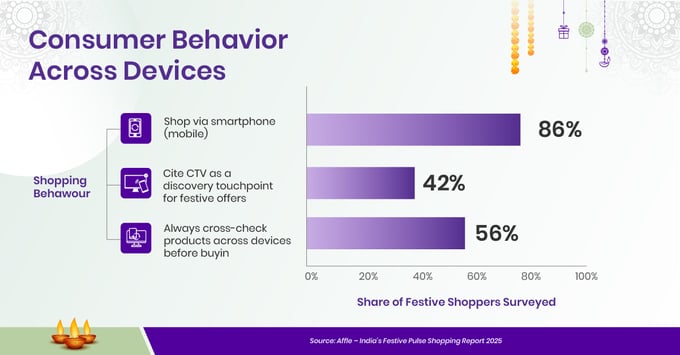
Mobile is still where festive shopping happens; 86% of shoppers use their smartphones to browse and buy. But Connected TV already shapes that decision before it gets there: 42% of shoppers cite CTV as a discovery touchpoint for festive offers, and 56% say they always cross-check products across devices before buying.
The question, therefore, shouldn't be: Should more of the festive budget go to CTV or mobile?
It should be: What does the consumer need from each screen at this stage of the journey?
Allocate Against Moments, Not Just Channels
A nine-week festive window creates multiple opportunities to influence consumer behavior. But it also means that applying the same media mix from start to finish can be inefficient.
Early in the season, consumers may be browsing, comparing and discovering. CTV can work as a performance channel in its own right—putting brands in front of relevant audiences while giving viewers a direct path to action. QR codes and other interactive calls-to-action can turn the big screen into a response channel, prompting consumers to scan, visit an app or continue their journey on mobile. At the same time, mobile can focus on user acquisition (UA), capturing consumers who are actively searching, browsing and showing early signs of intent.
As major sale events and festival peaks approach, the role of mobile becomes even more immediate: converting demand through installs, purchases and other high-intent actions. CTV can continue to drive action while extending reach and reinforcing the message, creating another opportunity to move consumers from the living room to their phones.
Post-peak, the focus shifts from capturing new demand to re-engagement and retargeting (RT). If high-intent behavior continues beyond the festival itself, marketers need to think beyond the traditional “launch, peak, stop” model. Mobile can bring back users who browsed, installed or showed intent but didn't convert
In other words, the budget should move with consumer intent and not remain locked into a fixed channel split for the entire festive season.
A Framework for Splitting the Budget
Rather than a fixed percentage split for the whole season, festive budgets are best allocated against the shape of the season itself, which typically unfolds in three phases.
Pre-festive build-up (weeks 1–3): weight toward CTV and broad-reach mobile. This is when category consideration forms. CTV's large-screen storytelling is well suited to seeding awareness around new launches, offers, and gifting occasions, while mobile prospecting campaigns build the top of the funnel among high-LTV audience segments.
Peak festive week: shift weight toward mobile and CTV acquisition together, with retargeting layered in. This is the highest-intent window, and both channels need to convert, not just reach, mobile campaigns can react to demand spikes almost as soon as they happen, since click and install data feeds back into bidding and creative decisions quickly, while CTV keeps driving installs and conversions in parallel through cross-screen attribution, with its view-through data resolving over a longer lookback window.
Post-peak extended window (weeks 4 and beyond): pivot hard toward mobile retargeting and reactivation. This is the phase marketers most often underfund, and it's a costly gap, AppsFlyer's Report found Gaming apps alone saw 29% post-peak install growth, driven by extended offers and gift redemption cycles. Dormant-user retargeting on mobile- re-engaging users who installed, browsed, or showed intent but didn't convert; deserves a much larger share of budget here than most plans allocate.
The Advantage is in the Optimisation
Getting the festive mix right is not a decision that should be made once and left untouched. With shifting demand, audience behavior and changing competition, the strongest strategies are built to learn and adapt as the season unfolds.
This is where programmatic can make a meaningful difference. Instead of relying on a fixed media plan, marketers can use real-time insights to identify where performance is changing and adjust bids, audiences, frequency and channel investment accordingly. AI-powered bid optimisation can help surface these opportunities at scale, while ongoing optimisation ensures that budget moves towards what is actually working.
This is where your DSP also makes a difference. A strong programmatic partner with cross-screen capabilities can help connect the customer journey and build on a smart plan with contextual signals, AI/ML-led audience intelligence, and optimization that goes beyond surface metrics. The marketers who treat CTV and mobile as one connected funnel, backed by cross-screen measurement, are the ones who will walk away from this festive season with the strongest ROI story to tell.
Unlock the next frontier of performance marketing. Team mDSP enables brands to capture the full value across CTV and mobile. Get started with us: https://mdsp.co/contact


-1.png)